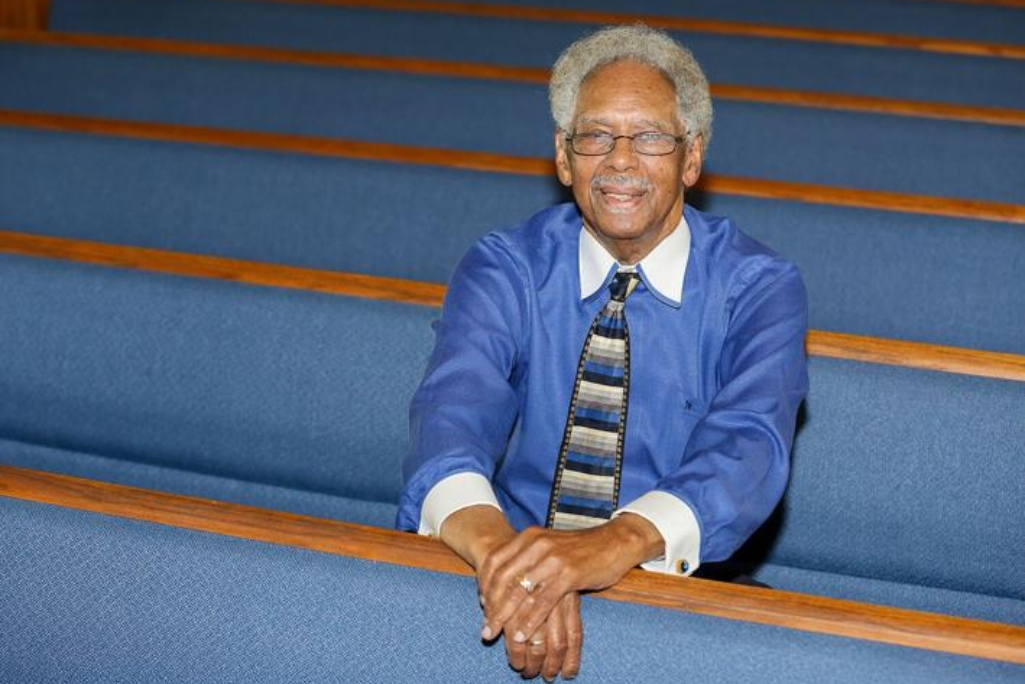
LOUISVILLE, Ky. — A legendary Kentucky Baptist pastor who faithfully served for more than six decades and who worked tirelessly to break down racial barriers has died at 94.
Lincoln Bingham, even after retiring in 2019 at the age of 87, could be found most mornings working at St. Paul Baptist Church at Shively Heights. That was the church that made national news in 2009 when an African American church (St. Paul Missionary Baptist) merged with a predominately white church (Shively Heights Baptist).
Mark Payton, who was the pastor at Shively Heights at the time, has known Bingham for more than 40 years and called him “one of the godliest and the most loving man he has ever met.”
Payton said working with Bingham on the church merger was “one of the smoothest things I ever did in 44 years of ministry. My oldest son said that Lincoln and I were the only guys who could pull it off.”
He said they began talking about the merger in March 2009 and combined for the first service on the third Sunday of August that same year.
Todd Gray, executive director of the Kentucky Baptist Convention (KBC), said Bingham’s 35-year tenure with the KBC helped bridge a significant racial divide.
“Reverend Lincoln Bingham is a legendary figure in Kentucky Baptist life, especially in the area of race relations among Baptist brethren, and churches,” he said. “In 1976 the Kentucky Baptist Convention formed the Department of Interracial Cooperation to promote close and more effective cooperation between white and black Baptists in Kentucky.
“Rev. Bingham was instrumental in the development of this initiative and in carrying it out. It is a testimony to his effectiveness, and favor with God and man, that many, if not most, of the traditional African American Baptist churches affiliated with the KBC did so at the encouragement of Bro. Lincoln Bingham.”
Bingham pastored four churches
Bingham’s involvement with St. Paul Missionary Baptist Church began years prior to the merger with a phone call from a former pastor in Hopkinsville, Ky. “He cried out to me, ‘Go and help that church.’” Bingham was working for the Kentucky Baptist Convention at the time and was able to serve the church in addition to his KBC responsibilities as cooperative missions consultant.
“The church (St. Paul) started growing — I was there about 15 years, then brought it here to merge. This (St. Paul) is a place of Christian love,” Bingham said at the time. “I have never been treated any better, loved any more, than I have been here.”
St. Paul was the fourth church Bingham pastored, but he never sought any of those positions. “The Lord led me to all those ministry positions. I never applied for anything. It’s like the song we sing, ‘Wherever He leads I’ll go.’”
God called Rev. Bingham to preach in 1959. He was ordained at Elim Baptist Church in Louisville, under the pastorate of Rev. W. F. Fisher on Sept. 30, 1960.
Bingham’s first pastorate was in Mercer County, Ky., for a congregation of about eight people. He was asked to preach there, and on that Sunday the church’s retiring preacher pointed to him and said, “There’s your pastor.”
The church grew, then West End Baptist in Louisville called him. That, too, was a small congregation of eight to 10 people which grew to about 300. He left there after a 35-year tenure to take a position with the Kentucky Baptist Convention.
In 2023, Bingham had a street named after him — the street he and his wife, Lillian, lived on for 55 years in Louisville. The occasion also coincided with their 72nd wedding anniversary. He and his wife were commissioned as home missionaries by the North American Mission Board in 1976.
‘One of the greatest churchmen we’ve seen’
Todd Robertson, the associational mission strategist for the Louisville Regional Baptist Association, said, “Lincoln was a dear friend and one of the greatest churchmen we’ve seen in this region and state.”
Bingham’s friendship with Payton was crucial in merging the churches that they copastored.
“Mark and I had been friends — everywhere he had gone he had me come and preach revivals for him. My wife and I stayed in their home. And wherever we went — conferences or meetings — he’d find me,” Bingham said in a 2019 interview.
“When that church was declining in membership, he called and talked about merging. I met with our church and over 120 people agreed to it. I prayed about it and thought it’d be the right thing to do. Our friendship would justify it because a friend will try to help another friend.”
Four years into the merger, Payton surprised Bingham by accepting a position elsewhere. “I never expected it to happen. I thought he’d be the pastor,” Bingham said. “When I retired from KBC, I thought I would stay here a little while to help. I thought I’d be retired completely. But after four years I became the only pastor.”
Known nationally for his work on racial reconciliation, Bingham modeled the attitude he believes is essential for that process to take place. “God so loved the world, that He was willing and did die for us. Because of that, I love people,” he said. “I love people because God loved me as a person — I am willing to do what God would have me to do.
“If others see Jesus in us … it will attract people regardless of race. It will have the effect it should have. If they don’t see Jesus in us, you can hardly expect them to be moved to act accordingly.”
Payton said he first met Bingham at a World Missions conference at Beaver Dam in 1985 and they quickly connected — despite opposition.
“I had him for revival and there were church members who would not come. They were mad because he stayed at home with us in our house.”
Payton said when Bingham met his 6-year-old son who was looking at him a little differently. “Lincoln said, ‘He’s never seen a black guy, has he?’ At that point, he hadn’t.”
They worked well together at the church, sharing the pulpit from week to week. If the Holy Spirit had urged one of them to speak on a Sunday when they weren’t scheduled to be in the pulpit, a change would be made with no issue, Payton said.
“We didn’t want to get into a personal contest,” he said. “We had the freedom with each other, even if we had preached the week before. It was a great relationship.”
They maintained staff from both churches and had Sunday School teachers from both churches. Like the pastors, the teachers alternated sharing the lesson each week.
Family history important in Bingham’s story
Family history played a significant role in the Bingham story. His grandfather, who lived to be 100, had been enslaved, but Bingham said he “never had any gripes or complaints.”
His father was a role model for him in faithfulness. “My father was a great man of God. There were 10 children in our family — my father loved God and loved people. He seldom complained about anything. His love had a powerful influence on me. I wanted to be like my father. While he was not educated, he was gifted and talented and a great servant of God.
“The difference in my life is that my grandfather loved; my father loved; it made my situation much better,” Bingham said.
“Not only has that been a part of my heritage, but it has helped me in congregations. I have gone into churches where no one shook my hand except for the (host) pastor when he came in, but after I preached, they would come and shake my hand. I think it was evident to them that I loved them.
“Certainly, people see love,” he said. “It’s not about how good I can preach, it’s that I have the power to love. If we’ll get that over to people, we’ll be making a difference in reaching lost people. People want it, they just don’t have enough models to see.”
“I know Kentucky Baptists will join me in our profound appreciation for Rev. Bingham’s leadership and in our prayers for his family at his passing,” Gray said.
“May the Lord’s blessings abide on the Bingham family today and the days ahead and may the work he began continue to be strengthened in Kentucky Baptist life.”
(EDITOR’S NOTE — Mark Maynard is managing editor of Kentucky Today. This article originally appeared in Kentucky Today.)