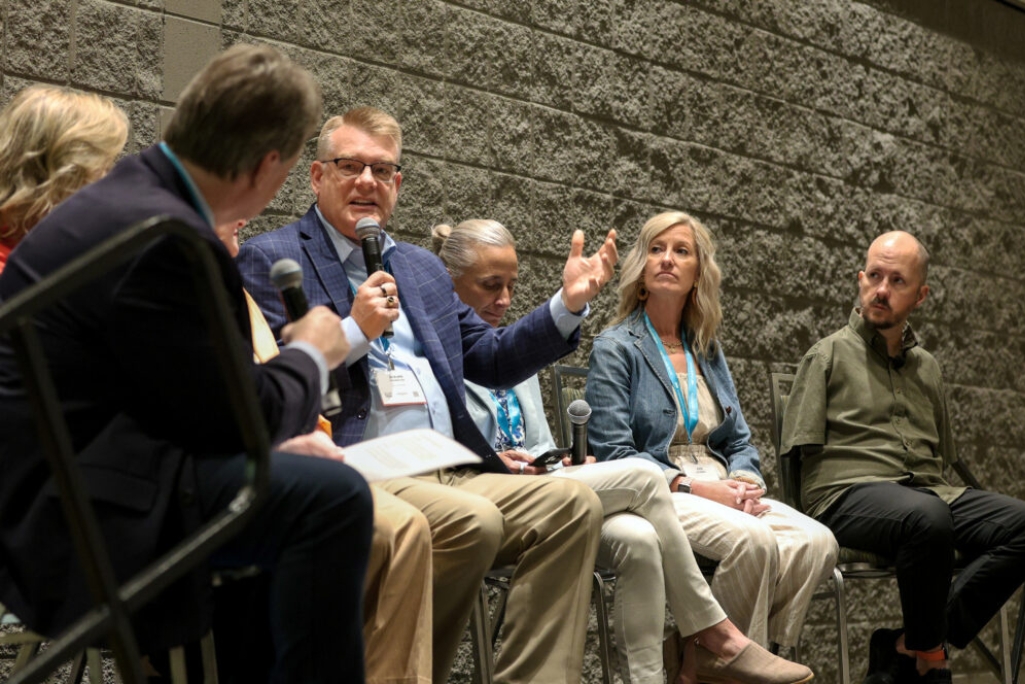
Shawn Thornton, president of Joni and Friends, speaks during a panel discussion at the Stand Up luncheon, an Evangelical Council for Abuse Prevention event held during the SBC annual meeting in Orlando, June 9. Joining Thornton on the panel, from left, were moderator Tom Stolle, executive director of the Baptist Convention of Maryland/Delaware; Julie Lowe, licensed professional counselor and former faculty member at the Christian Counseling and Educational Foundation; Kathy Kovalchuk, special needs minister at Prestonwood Baptist Church, Dallas; Kris Buckman, children and youth ministry consultant for the Baptist Convention of Maryland/Delaware; and Daniel Ritchie, a motivational speaker and advocate for disability awareness.
ORLANDO (BP) — Preventing the abuse of adults with disabilities in churches was the focus of a luncheon hosted by the Evangelical Council for Abuse Prevention at the Southern Baptist Convention (SBC) annual meeting June 9 in Orlando.
“Stand Up: Standing for Vulnerable Adults Against Abuse and Exploitation” was sponsored in part by the SBC Executive Committee.
Statistics indicate that 90% of people with intellectual disabilities will be sexually assaulted in their lifetimes, said Tom Stolle, executive director of the Baptist Convention of Maryland/Delaware (BCM/D), who moderated a panel at the luncheon.
Stolle has a 24-year-old nonverbal son.
“One of the things that I discovered early on was the fact that he was extremely compliant. He would pretty much do anything anyone asked, which made him incredibly vulnerable to sexual abuse,” Stolle said.
Stolle expressed gratitude for a room full of people who would say, “Not on our watch.”
Jeff Dalrymple, the executive committee’s director of abuse prevention and response, said the discussion is not an easy one, but it is important, and the task of raising awareness and equipping churches is still in its early stages.
Shawn Thornton, president of Joni and Friends, one of the nation’s leading Christian ministries dedicated to serving people with disabilities, said because adults with disabilities are among the most vulnerable populations, it is important for churches to emphasize protecting them.
In addition to Thornton, the panel included Julie Lowe, a professional counselor and abuse prevention educator; Kathy Kovalchuk, a special needs minister at Prestonwood Baptist Church in Plano, Texas; Daniel Ritchie, an evangelist born without arms and first vice president of the SBC; Sandra Peoples, a disability ministry consultant for the Southern Baptists of Texas Convention; and Kris Buckman, a founding member of the BCM/D’s sexual abuse prevention task force.
Ritchie said the vulnerable are close to the heart of God.
“You see it so many ways in the ministry of Jesus. So many of His healings and personal interactions are with the vulnerable,” he said. “You see how protective, how defensive Christ was of children, of the vulnerable.”
Because adults with disabilities are targeted for abuse, Buckman said it is vital that churches are more careful with the volunteers who will work with them.
“As we consider our policies and procedures, we really have to take a much deeper dive when we open these ministries, especially the screening process,” Buckman said. “We need to screen somebody a lot more intensely if they’re going to be a buddy or if they’re going to work with somebody.”
Asking scenario questions and contacting references are two ways to more highly vet such workers, she said, adding, “I don’t think inclusion and protection need to be competing priorities in the church. They go hand in hand.”
In the excitement of starting a disability ministry, “we sometimes lose sight of the protection factors when in reality they need to be much more robust,” Buckman said.
Kovalchuk remembered a mother crying as she dropped off her 19-year-old son at a church event for adults with disabilities. It was the first time the woman had left her son with someone, and the tears caused Kovalchuk to consider the trust the woman was placing in the church.
“I want to steward those relationships and those people well because God has entrusted them to us,” she said “… Doesn’t Scripture say that Christ advocates for us before our Father? We need to advocate for those who can’t advocate for themselves.”
Peoples said one way to be vigilant against abuse is to watch for warning signs. “Look for the response of a vulnerable adult,” she said. Such signs could include sudden reluctance to go to school or a new tendency to pull out hair.
Signs of abuse could swing the other way, Peoples said, such as an adult with disabilities who is too eager to be around a certain person. She advises parents to be wary of workers who are trying to isolate their sons or daughters, such as trying to be the only volunteers to work with them.
Lowe recommended “walking alongside and being a support, showing compassion and listening to what causes weariness” when churches consider where they could start to minister to families of adults with disabilities.
(EDITOR’S NOTE — Erin Roach is a writer from Mobile, Ala.)