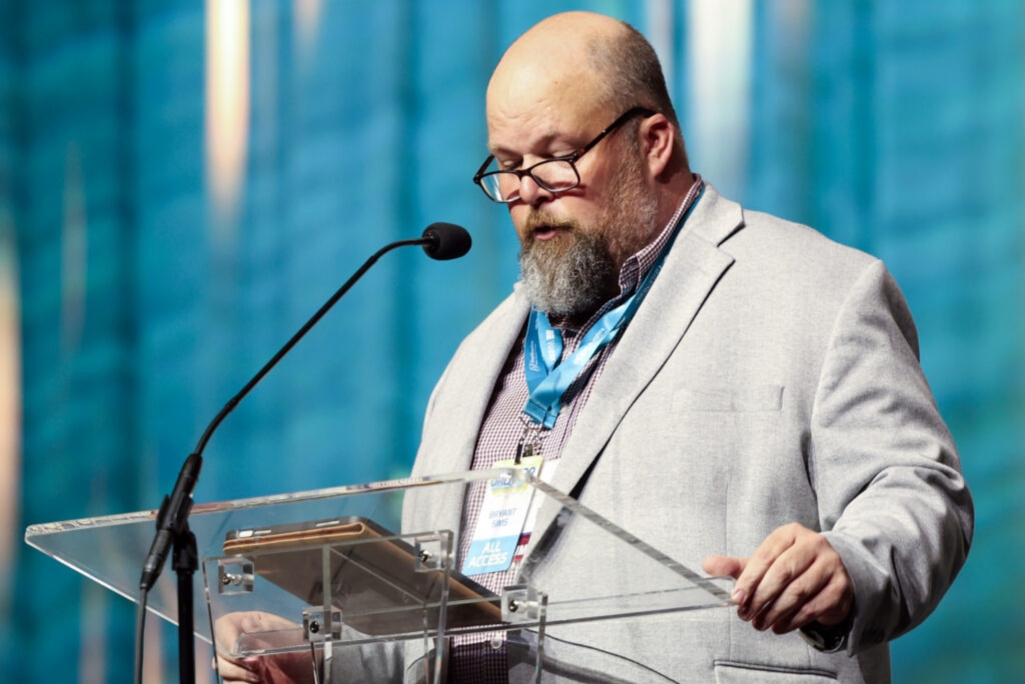
Bryant Sims, SBC Committee on Order of Business chairman and COO of the South Carolina Baptist Convention, informs messengers of the fate of various motions at the 2026 SBC annual meeting in Orlando.
ORLANDO (BP) — Southern Baptist Messengers (SBC) messengers are weary of task forces and study groups. They proved it June 9-10 with their votes on motions at the 2026 SBC annual meeting in Orlando.
Messengers also gave the first of two required two-thirds approvals of an SBC constitutional amendment limiting friendly cooperation to churches with only men in the office or function of pastor. The motion was submitted by Southern Baptist Theological Seminary President Albert Mohler.
One-third of the 30 motions made by messengers requested the formation of task forces or study committees. Messengers voted to indefinitely postpone nine of them, a parliamentary maneuver effectively killing the motions.
“As a person who just recently chaired a task force whose job it was to assess the work of another task force,” said Jay Adkins, chairman of the Great Commission Resurgence Evaluation Task Force, I’m “pretty tired of task forces.”
One motion requesting a task force on transparency and accountability was referred June 9 to the SBC Executive Committee (EC) and all SBC entities. Six motions requesting task forces or study committees were indefinitely postponed Tuesday.
Messengers voted June 10 to indefinitely postpone three more motions:
- That the SBC authorize its president to appoint a task force on messenger participation in the annual meetings, submitted by John Knudsen of Missorui.
- That the SBC form a task force to study the convention’s support of national Israel in light of increasing antisemitism, submitted by Matt Dunn of Missouri.
- That the incoming SBC president appoint a task force to study the responsibilities of entity trustees, submitted by Jerry Watts of Mississippi.
A motion by Robbie Gibson of North Carolina calling for an amendment to the SBC Constitution to clarify that only biological males may serve as pastors was referred to the EC automatically as a request for changes to a convention governing document.
The committee on order of business asked for a vote on Gibson’s tandem motion to suspend the SBC standing rule requiring referral to the EC of motions requesting changes to governing documents, but messengers voted against suspending the rule for Gibson’s motion.
Two additional motions were referred to the EC because they requested changes to SBC governing documents or the Baptist Faith and Message:
- That Bylaw 8 be amended to close online messenger preregistration at 11:59 p.m. the Monday before the SBC annual meeting begins, submitted by Gregory Mathis of Kentucky.
- That Bylaw 15 be amended to preclude from SBC entity trustee service anyone who is employed by any SBC entity or whose spouse is employed by any SBC entity, submitted by Michael Clary of Kentucky.
Also referred to the EC by a messenger vote was a motion that the EC study the possibility of offering meeting space to the SBC Pastors’ Conference at no cost or significantly lower costs, submitted by Joseph Dugger of Tennessee.
Referred to the International Mission Board (IMB), the North American Mission Board (NAMB) and all six SBC seminaries was a motion requesting written explanation of the alcohol policies of SBC mission boards and seminaries, submitted by Jared Long of Georgia.
Two motions asking the IMB to review its vaccine policies for missionaries were referred to the IMB, one by Michael Schneider of Missouri and another John Jones of Missouri.
Two motions were referred to NAMB:
- That NAMB publish the 10 largest payments it makes to contractors or vendors each year, by Jonathan Helvoigt of Colorado.
- That NAMB publish the total amount of money it paid annually for outside legal counsel and legal consultants from 2020-25, submitted by Wade Thomas of Kentucky.
Referred to Lifeway Christian Resources and all six seminaries was a motion that the seminaries and Lifeway report how they are addressing “widespread theological errors among American evangelicals regarding” the deity of Christ, the personhood of the Holy Spirit and the exclusivity of Christian worship, submitted by Malcolm Yarnell of Texas.
Seven motions were ruled out of order:
- That the EC report annually on the extent of participation in the annual meeting by messengers who have formal relationships with SBC entities or state conventions, submitted by Josh Abbotoy of Tennessee.
- That the convention set standards for music utilized at annual meetings, including a prohibition of songs that profit groups promoting false gospels, submitted by Jeremiah Hayes of Arizona.
- That the SBC ask each state convention to provide a remote SBC annual meeting site for smaller churches that cannot afford to send messengers to the main Annual Meeting site, submitted by Jim Cummings of Tennessee.
- That the committee on order of business be instructed to limit music and sermon times during the annual meeting and schedule more time for questions, discussion, motions and debate, submitted by Dean Scoular of Missouri.
- That the SBC condemn the theology known as “Kinism” as contrary to the gospel, submitted by Juan-Jose Cavallo of Florida.
- That seminary data reports include total expenses and change in net assets, submitted by John Piwetz of Kentucky.
- That the SBC expand resources for deaf churches, deaf pastors and deaf leaders, submitted by Brance Long of North Carolina.
“It saddened our committee to have to rule” Long’s motion out of order, said Committee on Order of Business Chairman Bryant Sims. Messengers paused to pray for ministry to the Deaf, led by SBC President Clint Pressley.
(EDITOR’S NOTE — David Roach is a writer from Mobile, Ala.)