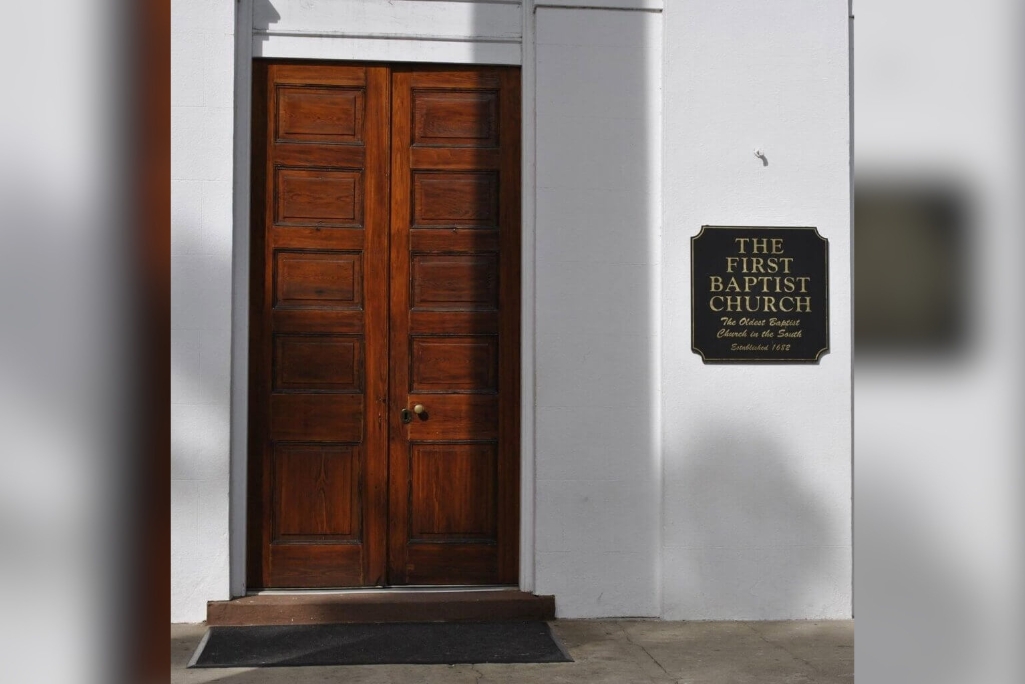
Many believe that a prayer meeting held June 28, 1776, at the First Baptist Church of Charleston, S.C., prevented British capture of the port on Sullivan's Island.
With few exceptions, Baptists across the colonies, especially those who had experienced persecution, supported the American Revolution. Reasons included persecution, other grievances including taxation without representation, and the tyranny exhibited by the British crown and royal governors. Baptists hoped to gain both political and religious freedom by supporting the war.
There were four primary ways Baptists supported the American Revolution — powder, pens, pulpits and prayer.
Powder
Many Baptists took up arms during the Revolution. Southern militias contained the names of Baptist ministers and laypeople who stood on the line in battle.
An article published by the South Carolina Baptist Historical Society in 1975 listed 15 Baptist ministers who served as officers or enlisted men and identified more than 600 Baptist laymen who served. Some support for the military came from churches like First Baptist Church (FBC) of Charleston, S.C., which provided funds from its treasury to support the war efforts.
Pens
Thousands of Baptists took up the pen which “is mightier than the sword.” Baptists published pamphlets, petitions and memorials, to which they signed their names. The documents called for tolerance, equality with other religious bodies especially in recognition of their ministers, the disestablishment of the state church and its taxes and for liberty of conscience and finally religious freedom.
Richard Furman and Oliver Hart of South Carolina wrote in opposition to the system of state support for church. In 1777, responding to pressure from Baptists and others, both South Carolina and Georgia ended the Church of England’s status as the established church, having the power to tax and to arrest for noncompliance with church laws.
In October of 1776, Baptists organized a petition calling for an end to all government interference in religion. Pages of the petition, signed by nearly 10,000 men, were sewn together into a 125-page document and presented to the first-ever meeting of the Virginia General Assembly.
Pulpits
Baptist ministers served as chaplains in both the militias and the continental army. Their preaching included comfort and encouragement to the troops serving in the field. Their voices in their local pulpits called weary Baptists to stand strong in their faith in the face of adversity.
Indicative of their support of the Revolution from the pulpits, half of the chaplains serving Georgia’s colonial militias were Baptist ministers. In Georgia, all the Baptist ministers except two, one of whom was a Tory, were forced to flee the colony during the war because of threats on their lives.
In South Carolina, Oliver Hart, pastor of FBC Charleston, was one of two ministers asked by the South Carolina Committee on Safety in 1775 to travel into the backwoods and explain to those living in those areas why they should support the Revolution. Baptist preacher Richard Furman served as a chaplain with a unit under the command of his brother. When Furman expressed interest in serving more with the military, South Carolina Gov. John Rutledge told Furman he was of more use to the cause of the Revolution in the pulpit than in the field.
Prayer
This was the most powerful weapon wielded by Baptists during the Revolution.
In 1780 when British soldiers under General Cornwallis successfully invaded South Carolina, he placed a bounty of 1,000 pounds on both Hart and Furman. Baptist tradition quotes Cornwallis as saying he “feared the prayers of Richard Furman” more than American generals.
Four years earlier, when the British were preparing to attack Charleston in June 1776, the situation for the city seemed hopeless. The colonists chose to defend the port on Sullivan’s Island near the channel opening to the Atlantic. A hastily constructed fort was assembled from the only materials available — flimsy palmetto trees.
The British planned to attack the island fort from two sides. British soldiers landed on another island, separated from the fort by what was believed to be a shallow channel. They would attack across the channel at low tide while the ships attacked from the main harbor.
Pastor Hart of the FBC Charleston had a son who was one of 500 defending the island. With little hope of victory against the world’s most powerful army and navy, Pastor Hart organized a prayer meeting at the church.
As the battle ensued, British soldiers attempted to cross the shallow channel but soon discovered that it was too deep and the currents too strong, and they were forced to retreat. Meanwhile the ships on the other side of the island began their bombardment of the fort. To the British and colonists’ astonishment, the cannon balls bounced off the soft, palmetto-log walls. Furthermore, because it was low tide, the British ships ran aground, becoming stationary targets for the cannons within the fort.
Defeated, the British retreated, and their strategy of taking a southern port early in the war vanished. News of the June 28 victory quickly reached Philadelphia, where the Continental Congress was in final deliberations over the Declaration of Independence. Bolstered by news of the victory, the congress adopted the Declaration of Independence a few days later on July 4.
Today this victory is remembered by the palmetto tree on South Carolina’s state flag. Current First Baptist Charleston Pastor R. Marshall Blalock will tell you it is also remembered by a prayer meeting at his church that changed the course of the war.
Powder, pens, pulpits and prayer were Baptists’ means of supporting the Revolution. The persecution in Virginia began to subside after the Revolution began, giving Baptists even more hope as they struggled for religious liberty. As the war continued, Baptists were pressing ahead realizing that political freedom and religious freedom go hand in hand. It’s an axiom which is still true today.
(EDITOR’S NOTE —Charles Jones is a retired pastor and Baptist historian who lives in Athens, Georgia. This article is Part 1 of a four-part series devoted to the role of Baptists in the development of religious liberty in America. Additional pieces will run, leading up to the nation’s 250th anniversary July 4. Read the entire series at the following links: Part 1| Part 2 | Part 3 | Part 4)