
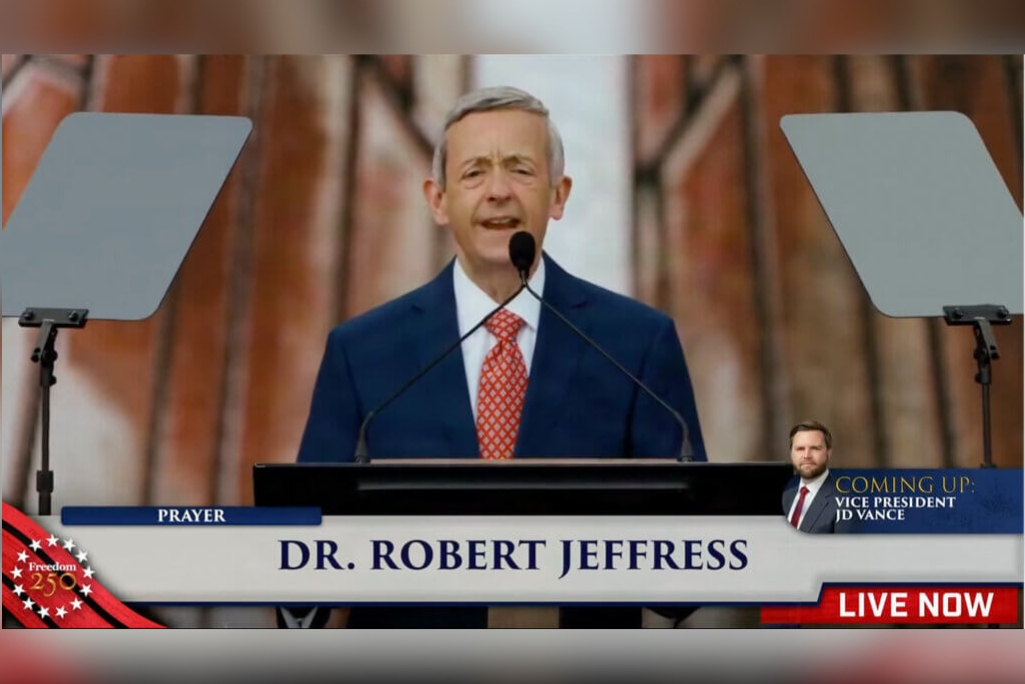
Robert Jeffress, senior pastor of First Baptist Church of Dallas, speaks on May 17, 2026, at the Rededicate 250 events on the National Mall in Washington, D.C. The event featured dozens of Christian legislators, pastors and leaders calling for the nation to recommit itself to God.
WASHINGTON (BP) — “If being a Christian nationalist means loving Jesus Christ and loving America, count me in,” proclaimed Robert Jeffress, senior pastor of First Baptist Church (FBC) of Dallas, on a recent Washington stage marking the nation’s 250th anniversary.
But is that what the term means?
“If by Christian nationalist you mean exalting the flag over the cross or loving America more than you love God, of course not. That is absolutely wrong,” Jeffress said to Baptist Press in explaining how he uses the term. “But if you mean by being a Christian nationalist, loving God and loving our nation; yes, I’m a Christian nationalist.”
Jeffress’ definition is perhaps a point on a spectrum scaling the benign to the extreme. While some are comfortable with the concept of the nation having been founded by Christians and thereby being identified as a Christian nation, at the other end of the spectrum are those blending church and state in a way that empowers a Christian leader as a somewhat modern-day biblical king.
Mark Caleb Smith, director of the Center for Political Studies and dean of the School of Arts and Humanities at Cedarville University, described to Baptist Press the vastness of the term’s diverging meanings.
“Its most simple, straightforward way would be … at one point, a majority of people in America were Christians. And as a country, the dominant religion was Christianity, and therefore America should be considered a Christian nation,” Smith offered as the most benign interpretation. “So it doesn’t have to do with structures of the government, it doesn’t have to do with the Constitution or anything official; it’s more of just a byproduct of the dominant majority religion.
“And so someone could say today, ‘I think America is a Christian nation.’ They may even use the label Christian nationalist, but they may mean it that way as opposed to the other ways that it could be meant.”
At the other extreme, Smith said, is “America should deliberately use the government to make sure that it continues to be and will always be a Christian nation, and the government structures, the law, the culture, all of these things should work together to uplift Christianity, to perpetuate Christianity and should reflect Christianity.”
Globally, at least 22% of all countries have declared a national religion, World Population Review wrote in 2026, relying largely on 2015 Pew Research Center numbers and other sources.
Notably, the small nation of Samoa, which shares an island with American Samoa, amended its Constitution in 2017 to declare Samoa was founded on a belief in the triune God, according to the U.S. State Department’s most recent International Religious Freedom Report compiled in 2023 under the Biden administration. Samoa’s constitutional preamble describes the nation of about 220,000 people as “an Independent State based on Christian principles and Samoan custom and traditions,” and the constitution itself as amended includes “Samoa is a Christian nation founded on God the Father, the Son and the Holy Spirit.” As such, the religious freedom specified in Samoa’s constitution has faced challenges in practice, according to the report.
The term Christian nationalism dancing across social media platforms and the public stage has attracted both favor and derision, with Smith diagnosing its use sometimes as a weapon to stir either celebration or rejection of America’s growing theological and ethnic diversity.
“I think the challenge of it today is more than at any other time in our country, America is a diverse place. It’s theologically diverse, it is culturally diverse, it’s racially diverse,” Smith said. “Some of the tension that we’re having right now is because of that diversity. And Christian nationalism, I think, is an outgrowth of that.
“It’s one way that some people are coping with a changing country, (proposing) we should be more deliberate about our Christianity in the face of that change.”
When you see the term, Smith encourages Christians investigate and research how a person is using the term and has used it before instead of attempting to take the term at face value or assigning a particular bias to it.
“When you read a tweet or when you read a Facebook post that uses Christian nationalism in the headline, it’s just never really defined. A lot of people just use the label. There’s no meaning attached to it,” Smith said. “The label is too broad, too diverse, too complicated to just be used in a simple way. It just doesn’t communicate all that much by itself.
“Maybe some people do deliberately distort it and use it as a slur. Maybe some people use it as a label for themselves, but have different meanings by it. I would say that it’s fairly difficult to define, but also when people use it, they don’t always define it, so it’s not always clear.”
Jeffress’ Christian nationalism
Jeffress, for one, defends his description of himself as a Christian nationalist, but also believes the nation’s Founding Fathers would have embraced the term.
“I think Christian nationalism has been used by the left as a pejorative against Christians who believe that our nation was founded as a Christian nation. And I believe that God will bless any individual or nation that reverences Him, and God will judge any individual or nation that rejects Him,” Jeffress told Baptist Press, referencing Psalm 33:12.
Jeffress readily offers that not everyone in America is Christian, and believes non-Christians should not be forced to adopt the faith.
“But I believe that what we should do is go back to our historic roots as a country and realize that we were founded as a Christian nation,” Jeffress said. “Our first chief justice of the Supreme Court, John Jay, talked about this Christian nation in which we had the opportunity to select our leaders. And so I am simply urging us to go back to those foundational Christian principles that made America what it is, while at the same time respecting people’s right not to agree.”
Baptists long suffered persecution in the early days of the nation, when Christian Congregationalism was more prevalent, as it is today in Samoa. There, 27% of the population aligns with the Congregational Christian Church of Samoa, according to the 2023 U.S. State Department report. At that time, the Samoan government used the Congregational Christian Church’s TV2 station to convey political messages, and since 2022, clergy in Samoa have been exempt from paying income taxes.
While the Samoan constitution guarantees religious liberty and protection against persecution, Samoans still reported undue pressure to support local churches.
“Community leaders again reported there was strong societal pressure at the village and local levels to participate in church services and other religious activities in addition to supporting church leaders and projects financially,” the report reads. “Social media posts suggested that financial contributions often totaled more than a third of family income. While data on contributions were not available, these social messages suggested that contribution pledges during the year were significantly greater than in 2022.”
Jeffress believes in erring on the side of tolerance, he said, respecting another person’s right to be wrong.
“God gives us the choice of choosing right versus wrong, and I think as a country we ought to always give people that option of choosing any faith or no faith,” he said. “But that doesn’t mean that we disregard our Christian foundation as a nation.”
For instance, Jeffress believes Rastafarian Damon Landor, in the case of Landor v. Louisiana Department of Corrections, while imprisoned should have been allowed to practice his Nazarite vow that forbade him to cut his dreadlocks. While the U.S. Supreme Court on June 23 blocked Landor’s right to sue for monetary damages the two Louisiana prison guards who forcibly shaved his dreadlocks, the court did not view the case from the point of religious liberty.
Finding the proper balance of religious liberty and governmental control under a Christian nation will be difficult, Jeffress believes.
“I realize it will always be a struggle to find that balance. But I think at the same time we need to realize that we have crossed the line in abdicating our Christian principles as a country,” Jeffress said. “I would support the right of this individual to wear his hair in a way that was in keeping with his religion. I think when it comes to religious freedom, if we’re going to err, it ought to always be on the side of religious liberty.”
But Jeffress decries various Supreme Court decisions dating from the 1960s, calling “ridiculous” the removal of prayer from public schools, ending Bible reading in schools and removing the right to post the Ten Commandments in classrooms.
“I think you’re seeing the courts start to reverse that and realize they had gone to an extreme in their effort to sever our nation from its Christian foundation. And so I think the starting place for a country is to rescind some of those beliefs and rulings that are anti-Christian,” Jeffress said, longing for laws preventing gay marriage and “guaranteeing people’s freedom to exercise their faith, both in private and in public.
“I think that’s the starting place,” Jeffress said.
Smith believes a proper balance is possible, but finds it far from reality.
“We think of ourselves as Christian, we’re going to have Christianity, but we also understand that you may not hold to that and we’re going to protect your ability to pursue religious questions as you see fit. Those things, I think they can go together, I think they could go together, but I think historically we see often they just don’t,” Smith said. “They don’t go together well.
“When you see governments using religion very prominently and making it a feature, defining themselves based on religion, then almost always you see a limit of religious liberty. And so that’s a tension that you see throughout American history.”
The more extreme the Christian nationalism, Smith believes, the more oppressive the religious persecution.
“Under the most aggressive forms of Christian nationalism,” he said, “it would lead to, obviously, a limiting of religious liberty. And people would not have the same freedom to pursue their faith as they do now.”
Smith believes it’s paramount to remember that Christ’s kingdom is not of this world, and that Christ rejected Satan’s temptation of a worldly throne.
“No matter what you think of Christian nationalism, whether you’re for it or against it, or whether you think it should be using the power of the government to force people into Christianity or whatever,” Smith said, “Christ’s kingdom is not here. It will never be here. He made that pretty clear throughout His ministry.
“He did not focus on building a political party or building a nation like that,” Smith said. “I think it’s good for Christians to keep in mind that Christ did not see His primary mission as a political mission. Whatever you think of what we ought to be doing, I think we have to at least keep that in mind.”
(EDITOR’S NOTE — Diana Chandler is Baptist Press’ senior writer.)