
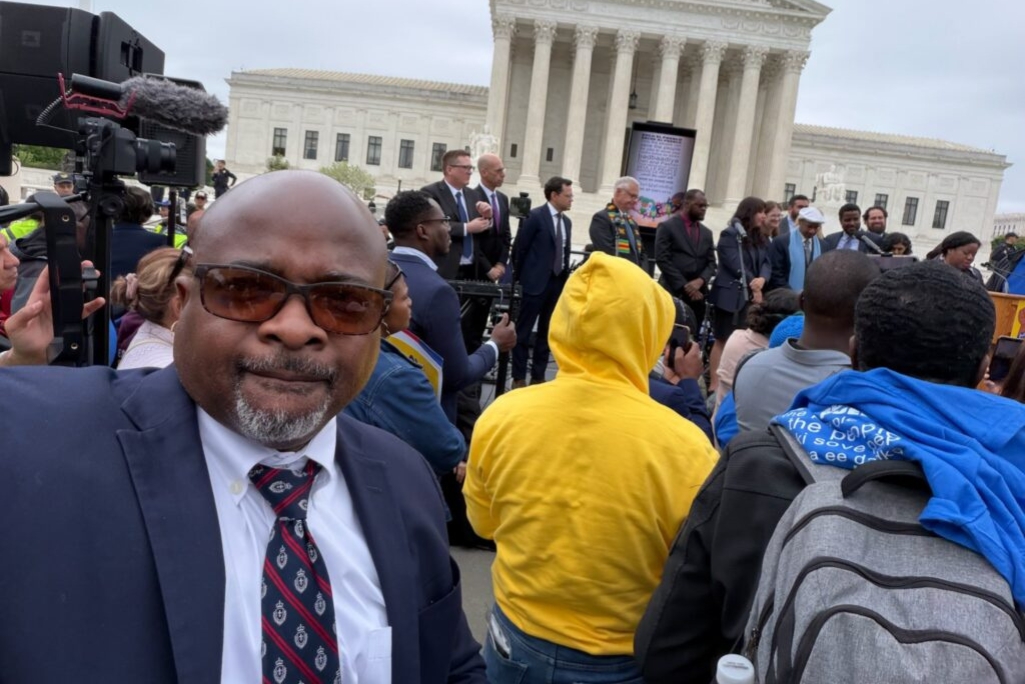
Pastor Keny Felix, foreground left, rallied for extension of Temporary Protected Status at the U.S. Supreme Court in April.
WASHINGTON (BP) – More than 1.3 million immigrants are set to lose their legal residency here after the U.S. Supreme Court ruled against Haitians and Syrians seeking an extension of Temporary Protected Status (TPS) first issued decades ago.
As Congress established TPS in 1990 for immigrants fleeing dangerous homelands, the program clearly and broadly does not allow judicial review, the court said in its 6-3 ruling in Mullin v. Doe.
“We first consider respondents’ non-constitutional claims and conclude that we are barred from reviewing them,” Associate Justice Samual Alito wrote in the majority opinion. “There is no judicial review of any determination of the (Secretary of Homeland Security) with respect to the designation, or termination or extension of a designation, of a foreign state under this subsection,” the court quoted a text from Section 1254 of the statute. “This text is clear, and its plain meaning is very broad.”
And while Haitians cited racial animus in the administration’s call to end TPS for the 350,000 Haitians living legally here — noting racially charged accusations that Haitians were eating neighbors’ pets in Springfield Ohio in 2025 — the court said such a charge would likely fail on its merits.
Southern Baptist Convention (SBC) National Haitian Fellowship President Keny Felix expressed alarm and disappointment at the court’s opinion, describing the issue as one of life.
“This ruling impacts our neighbors, coworkers, fellow congregants and families who are seeking protection from devastating life circumstances. Ethnic churches across the Southern Baptist Convention will feel the impact of the decision if the administration moves forward in rescinding TPS for various nations, including Haiti,” said Felix, senior pastor of Bethel Evangelical Baptist Church in Miami and a Haitian immigrant since age 7. “But this (is) not solely a Haitian issue. It’s about our collective responsibility to protect vulnerable families and communities. This is more than an immigration issue. It’s a human life issue.”
Felix, who has advocated extensively for Haitians and others from 17 countries with TPS status, now looks to Congress.
“Our only recourse now is to plead with senators to choose life and vote in favor of the present Senate bill (S.4814) to extend TPS for Haitians that was introduced last week by Sen. Ed Markey (D-MA) and co-sponsored by 18 senators,” Felix said. “The House version of the bill to extend Haiti TPS for three years, H.R. 1689, was passed by a bipartisan vote on April 16th.”
Southern Baptists have addressed the issue of immigrants in several resolutions, most recently at the 2026 SBC annual meeting in the resolution “On Immigration, Human Dignity, and the Rule of Law.”
The resolution did not address Haitians and Syrians specifically, but included among eight resolved statements, “That we also reject nativism, racial or ethnic hostility, ethno-nationalism, discrimination, and all ideologies or rhetoric that deny the equal worth and dignity of any people group regardless of immigration status, while also affirming that Christian compassion and hospitality do not negate lawful order or excuse indifference to public justice and social peace (Ephesians 2:14-19; Hebrews 13:2).”
Charles Owusu, president of the SBC Ghanaian Fellowship, said that while the decision doesn’t directly impact his pastorate, Word of Life Baptist Church in Lithia Springs, Ga., the ruling puts many in danger.
“This ruling will throw our brethren from Haiti and other affected countries into fear and confusion, many of whom are not only living peacefully in the U.S., but also contributing towards the spiritual and economic growth of the United States,” Owusu said. “A more humane approach to the enforcement of this ruling will keep our brethren protected from the unstable and dangerous situation that persists in Haiti and the other countries.”
In a dissenting opinion joined by Associate Justices Ketanji Brown Jackson and Sonia Sotomayor, Associate Justice Elena Kagan said the statute creating TPS does not prohibit judicial review.
“Its judicial-review bar applies not to everything the secretary does under the law, but only to her ‘determination’ ‘with respect to the designation, or termination or extension of a designation, of a foreign state,’” Kagan wrote. “To preclude review of those determinations is of course to insulate critical matters from judicial scrutiny.”
Rather, Homeland Security then-Secretary Kristi Noem did not follow the statute’s requirement to consult with appropriate agencies about conditions in the countries at issue, said Kagan, who also gave credit to Haitian plaintiffs’ charges of racial animus.
“The Haiti plaintiffs have yet another claim that is likely to succeed: that race entered into the decision to terminate Haiti’s TPS designation, in violation of equal protection,” Kagan wrote. “Our decision in Arlington Heights v. Metropolitan Housing Development Corp., 429 U. S. 252 (1977), supplies the standard for assessing that claim.”
Congress established TPS in 1990, with then-Secretary of Homeland Security Janet Napolitano extending TPS to Haitians in 2010 after a devastating earthquake, and in 2012 to Syrians under the regime of Syrian dictator Bashar al-Assad. While the designations were initially for 18 months each, they were extended under several administrations until 2025, when Noem announced plans to terminate TPS for Haitians and Syrians.
Noem claimed a new Syrian government was attempting to “move the country to a stable institutional governance,” Amy Howe wrote at scotusblog.com, “and that she had determined that ‘there are no extraordinary and temporary conditions in Haiti that prevent Haitian nationals … from returning in safety.’ And in both cases, she indicated that it would be ‘contrary to the national interest’ to allow the countries’ TPS designation to remain in place.”
(EDITOR’S NOTE — Diana Chandler is Baptist Press’ senior writer.)