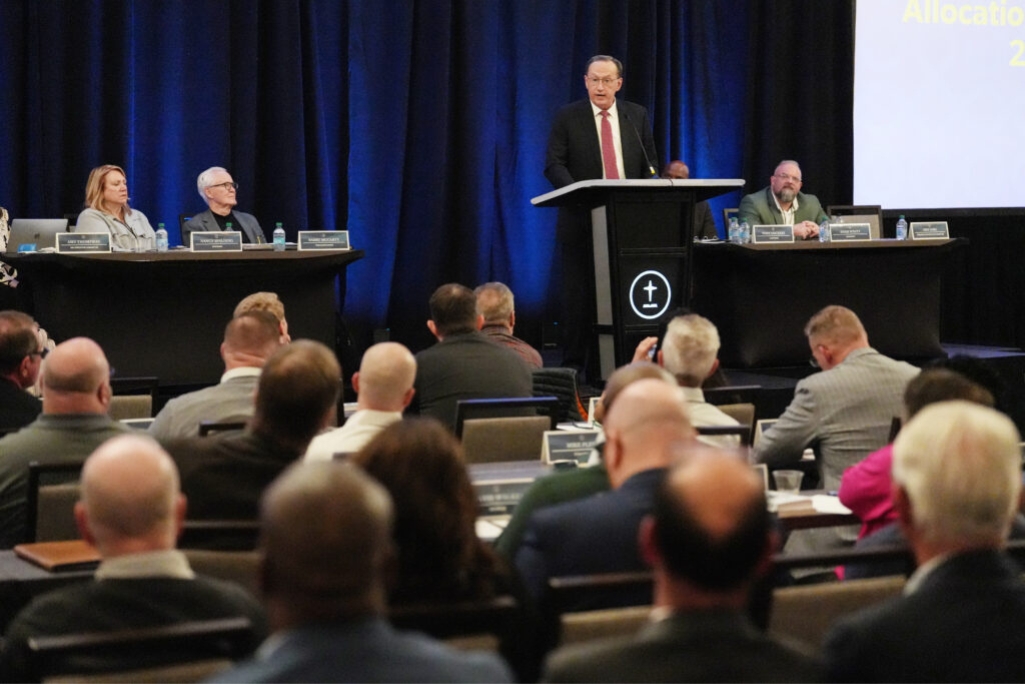
SBC Executive Committee President Jeff Iorg speaks to the Executive Committee Feb. 16, 2026, in Nashville.
NASHVILLE (BP) — In 1917, Southern Baptists decided the convention needed a central office to handle its business throughout the year. When the Cooperative Program (CP) was established a few years later, the Southern Baptist Convention (SBC) Executive Committee (EC) received a small portion of the budget each year.
By 2010, the EC’s share of the CP budget was 3.4%. That year, messengers to the SBC annual meeting in Orlando approved recommendations by the Great Commission Resurgence Task Force (GCR) that included a 1 percentage point Cooperative Program reallocation from the EC to the International Mission Board. The vote called for the EC’s percentage to be reduced from 3.4 to 2.4 so that the IMB’s could go from 50 to 51.
Small steps came incrementally in the following years. The IMB’s allocation percentage moved to 50.2% in 2011, then to 50.41% in 2013, where it would remain.
In February, executive committee members voted for the EC’s Cooperative Program allocation to be adjusted from 2.99% to 2.65%. Under no compulsion to do so from the GCR report adopted by messengers in 2010, other entities also adjusted their CP allocation percentage to help meet the goal:
- North American Mission Board — 22.79% to 22.64%
- Seminaries and Historical Library & Archives — 22.16% to 21.83%
- Ethics & Religious Liberty Commission — 1.65% to 1.64%
In terms of dollars received, of course, that depends on how much Southern Baptists give through the Cooperative Program. The proposed 2026-27 budget of $186 million reflects a $4 million drop from its most recent predecessor, but a $3 million priority allocation to cover the SBC’s legal expenses for 2025-2026 is no longer in effect. All told, the IMB is expected to receive about $593,000 more next year, enough to send around seven new missionary units to the field.
“It was the right thing to do,” EC President Jeff Iorg said on fulfilling the allocation. “Southern Baptists, including the executive committee, want more resources to go to international missions. It’s what we’re about. It’s what we’re focused on.”
Adjustments after GCR
The changes in 2010 didn’t come without an effect on the EC.
EC leaders began months after the GCR adoption with structural and staffing changes that November. EC staff went from five divisions to three, combining news services and convention relations while bringing a separate department for Cooperative Program promotion into the president’s office. Two vice president positions were eliminated.
Despite cuts to its allocation, the EC’s responsibilities grew in the years following the GCR’s adoption.
In 2011, messengers overwhelmingly approved a recommendation for greater ethnic diversity in the SBC. Those reports from the entities were sent to the EC and compiled by a subcommittee. A decade later, more than half of the appointments for SBC committees were non-Anglo. The 2012 approval of “Great Commission Baptists” as a descriptor split pastors on its usage, though the EC was required to manage the dual-identity branding — an administrative responsibility without precedent. The financial reporting metric of Great Commission giving generated much debate before the GCR vote and most of the floor discussion at the annual meeting.
The GCR Evaluation Task Force report delivered in 2024 called Great Commission Giving “poorly defined and never fully adopted by the broader Southern Baptist family,” and said it should not be used further. The 2025 Annual Church Profile form was the first to no longer include it.
In September 2023, ongoing legal fees resulting from a sexual abuse investigation and a net loss of more than $6 million in assets during the 2021-2022 fiscal year factored into the elimination of five staff positions and two contractor positions at the EC. Approximately $13 million in legal fees and other costs spurred by the Guidepost Solutions report effectively drained the EC’s reserves and preceded another reorganization of leadership the following year.
Various cuts left the executive committee with a staff of 21 full-time employees. The addition of the Abuse Prevention & Response office, which is funded by a gift from Send Relief, has brought the current number to 22. The total number of EC staff has been reduced by more than one third since 2010.
The 2024 GCR Evaluation Task Force reiterated the 2010 call to move the IMB’s allocation to 51%, saying it would “finally correct the Executive Committee’s lack of responsiveness to the will of the messengers.” Should messengers adopt the proposed CP allocation budget for next year, the EC’s budget will be reduced significantly, though other SBC entities will share the load.
Iorg knows the value in doing something, even if it’s going to be uncomfortable. He is just two years into his current role at the EC, officially starting on May 13, 2024. Ten years earlier, as president of Golden Gate Baptist Theological Seminary, he led the entity through a relocation and name change to Gateway Seminary.
“No matter when you make this kind of change, it’s going to come with challenges,” he said of the allocation move, “but it’s still the right time.”
EC’s history and purpose
The executive committee’s roots go back to the 1916 annual meeting, when Texas messenger M.H. Wolfe called for an amendment to the SBC Constitution “so as to create one strong Executive Board which shall direct all of the work and enterprises fostered and promoted by this Convention.”
A committee of 11, plus Wolfe, met over the next year and presented its report at the 1917 annual meeting on creating “one strong executive board.”
“Distressing conditions,” they said, from the ongoing world war brought them to the agreement that existing convention boards should remain separate. However, there was also strong sentiment to create “an executive committee of seven, representing the different parts of the territory of the Convention.”
Duties for the seven-member committee included arranging for the annual meeting and, if necessary, changing its location. It shall act on matters between annual meetings that pertain to SBC business. It could act in an advisory role on questions submitted to it that pertained to other boards.
In 1927, the committee became an agency of the convention with a staff, office and executive secretary. Other roles and staff were added through the years.
Today, the EC assists churches through seven ministry responsibilities (as laid out in the SBC’s organization manual):
- Conducting and administering the work of the convention not otherwise assigned. (This includes things like supporting the work of the SBC Credentials Committee and facilitating any task forces appointed by the SBC president.)
- Providing a convention news service, Baptist Press.
- Developing and strengthening cooperative relationships.
- Assisting churches, organizations and individuals with investment management and generosity.
- Promoting the Cooperative Program and celebrating other cooperative giving.
- Providing stewardship education.
- Elevating the ministry of prayer.
Today, there are 86 trustees on the executive committee. It consists of pastors from churches of various sizes scattered throughout the Southern Baptist Convention, laypeople and community and business leaders. They gather each September and February, and again prior to each SBC annual meeting.
The general duties laid out by the EC are undertaken throughout the year by the EC staff, based in Nashville.
CP holding steady
There were concerns the one-time $3 million priority allocation last year for legal costs would damage CP giving, “but that hasn’t really happened,” Iorg said.
“We had bills to pay. We needed to take care of, and we did,” he said. “Cooperative Program giving has held steady through this year as compared to last year. And while we’re all hoping for growth, of course, all the time, I’m simply grateful at this point that Southern Baptists have held the course.
“I’m delighted (about the IMB’s move to 51%). While it’s going to be a strain for us here at the executive committee to figure out how to make all that work, we’re committed to doing it. Because just like the rest of Southern Baptists, we are primarily committed to getting the gospel to places where it’s not yet been preached and the name of Jesus has not been heard.
“This is an opportunity for us to do that.”
(EDITOR’S NOTE — Scott Barkley is chief national correspondent for Baptist Press.)