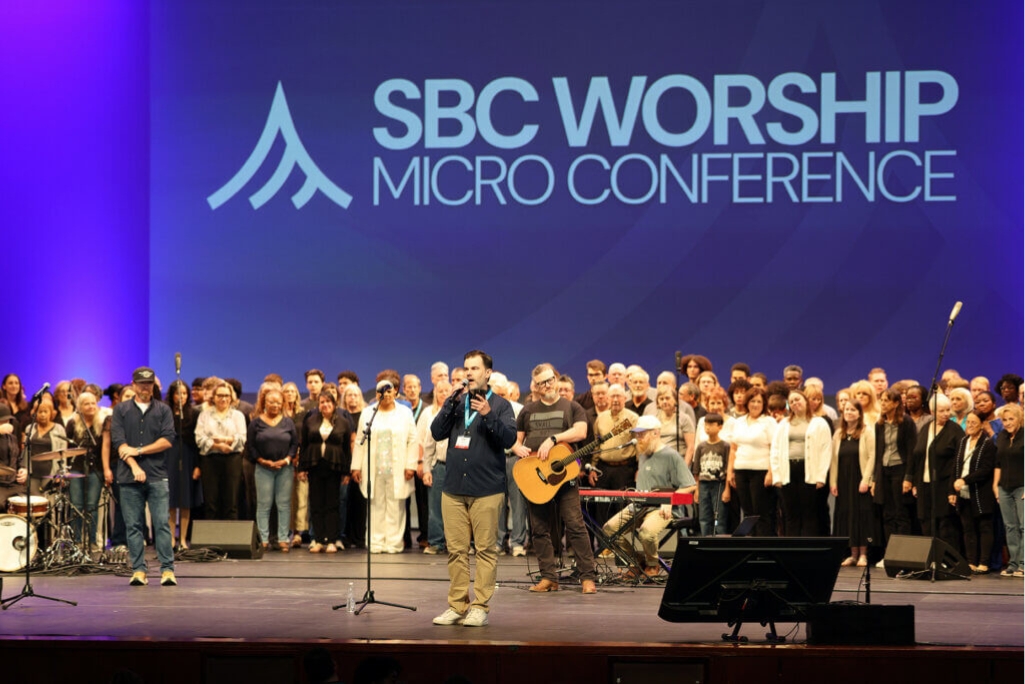
Andrew McKinney, head of The Worship Initiative, speaks in the first part of a two-part microconference for worship leaders June 8. The morning session featured a choir made up of members from various Orlando-area churches.
NASHVILLE (BP) — It’s not an overstatement to say the addition of microconferences to the Southern Baptist Convention (SBC) Pastors’ Conference in Orlando may have fundamentally shaped the way church leaders see the SBC annual meeting itself.
That’s the sentiment of leaders, noting the attendance and feedback of those attending the micro-conferences directed at worship, discipleship, students and kids ministry.
“People want to be represented at the annual meeting,” said Andrew McKinney, head of The Worship Initiative. “Having a church’s full staff attend the annual meeting is a wonderful thing, and helps it serve its ultimate goal.”
McKinney is also part of the advisory council for SBC Worship, which, alongside The Worship Initiative and Lifeway Worship, was a key sponsor for the worship microconference on June 8 that ran in conjunction with the pastors’ conference. Aaron Burgner, lead pastor of Lakes Church in Lakeland, Fla., served as pastors’ conference president and announced the inclusion of microconferences earlier this year.
The number of worship leaders attending the annual meeting in Dallas last year was 400, McKinney noted. That number quadrupled to 1,600 in Orlando.
“It’s good for our convention to see different staff roles being represented,” he said. “I was greatly encouraged by that. They feel like there’s something meant to invest in them and build them up, so they want to maximize the opportunity when we gather as a convention.”
On that note, McKinney was equally encouraged by the 150 senior pastors who signed up for the worship microconference.
“They can be deeply invested in the area of worship, to get clarity and be able to partner with whoever’s leading the service,” he said.
The 9-11 a.m. main session’s 1,183 attendees heard from recording artists Shane & Shane; Robbie Seay, executive vice president of The Worship Initiative; and Matt Boswell, worship pastor and Midwestern Baptist Theological Seminary professor. Total attendance for the afternoon breakout sessions came in at 1,155.
Feedback from attendees has been “overwhelmingly positive,” McKinney said.
“People are longing for this. They were able to come together and ask questions on subjects affecting them week in and week out as they lead their churches and hear from trusted voices. It also gave them the chance to be a part of worship and be fed (spiritually) instead of leading it.”
That time of worship included a choir in the morning session made up of those from a half dozen local churches.
“Central Florida is a diverse place, and it was multi-ethnic, multi-generational … a powerful morning of worship,” he said.
The background for needing such a conference is grounded largely in the need for more worship leaders.
“I think the average age is 53,” McKinney said. “Just by retirement age, we’re going to need 20,000 new, trained worship leaders in the life of SBC churches by 2040. Right now, we’ve identified only about 11,000 currently in the training pipeline.”
There are reasons — alongside the microconference results — to be positive in meeting the challenge. The Southern Baptist Church Music Conference has been reinvigorated in recent years. Next February, Southwestern Seminary will host a worship conference through SBC Worship similar to the one in Orlando.
The observation from McKinney and others is that worship leaders want to grow in their involvement in the annual meeting. “They are excited and want to get involved, to be equipped for the weighty task of putting the Word of God” in others’ minds, hearts and mouths.
There are three strategic areas planned to accomplish that:
- Use research and be driven by data. “This isn’t about emotions or preferences. We want to continue to ask questions about what is true in the life of the local church.”
- See an increase in songwriting in the SBC. “We haven’t done a proper job to elevate the songs coming out of our churches, and are excited to do that.”
- Equip and encourage the next generation. “That 20,000 number is glaring at us. We need to call out those in our churches.”
There is also a desire to equip churches that struggle for resources. A preliminary overview from a survey earlier this year — full results scheduled to be released in August — gave conference attendees initial findings.
“The survey made it abundantly clear that churches of 500 (in worship attendance) have a lot of resources, while those of 100 or less struggle. We would love to see a meaningful movement of figuring out how to resource the normative SBC church. If we don’t serve that group of churches, what are we doing it for?”
(EDITOR’S NOTE — Scott Barkley is chief national correspondent for Baptist Press.)